About the ranking of search results
Search engine providers usually restrict insights into the ranking process of search results. This article gives insights search results are ordered using the search engine on umwelt.info.
What is the purpose of ranking search results?
The ranking of search results is important to obtain the most relevant information as quickly as possible. A submitted search query is compared with all entries in the search index - the database of referenced information and data in umwelt.info. This comparison identifies the entries that are most relevant to the respective search query.
Based on this, the order is determined and suitable search results are placed at the top of the results list.
Which factors influence the ranking?
The ranking on umwelt.info is based on five factors:
- BM25 ranking
- Recency
- Metadata quality
- Popularity
- Status.
These five factors are used to determine a score for each entry. The higher the overall score, the higher up an entry is positioned in the results list.
BM25-Ranking
Recency
Metadata quality
Popularity
Status
Ilustration of the five factors that influence the ranking of search results.
How are the factors weighted?
All factors considered are weighted and result in a total score for each entry. This then determines the order in which the search entries are displayed. The BM25 ranking algorithm has the strongest influence on the ranking, followed by the topicality of the entry. The factors metadata quality and popularity only have a minor effect on the positioning. You can find the implementation in our code on GitLab.
- BM25: 85,9%
- Recency: 8,9%
- Metadata quality: 2,8%
- Popularity: 2,4%
For example, if two entries are close to each other in the BM25 score, a current entry with higher metadata quality and/or popularity would tend to appear higher up. On the other hand, it should be avoided that non-current records with high quality and popularity are prioritised too strongly. This could lead to entries with a relatively low match with the search query still being positioned at the top of the results list.
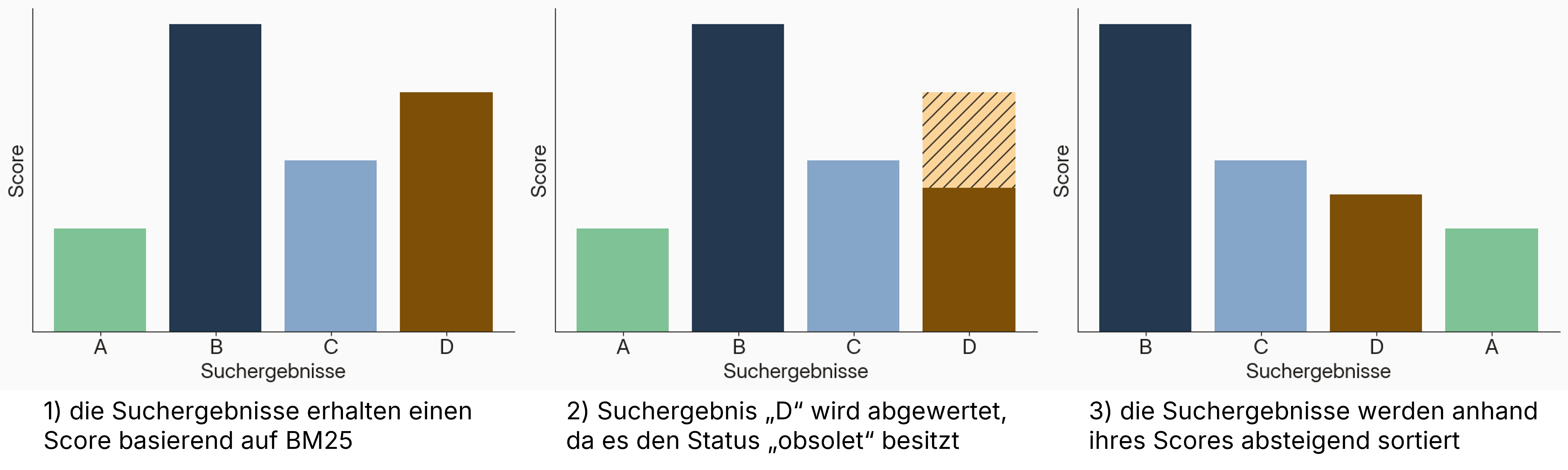
The status is irrelevant in most cases and is set to active by default, which does not affect the ranking. It is mainly used to devalue obsolete entries. These are multiplied by 0.6 in order to place them lower correspondingly. This means that users are more likely to see active and therefore more relevant entries higher up in the results list. Entries that are under development or in planning are also devalued slightly by multiplying them by 0.95.
Fictitious example of the ranking 1) Search hits are rated based on BM25 2) Status of search hit ‘D’ is ‘obsolete’, so ‘D’ is devalued. 3) Search hits are sorted in descending order according to their score.
How can users and data providers help to improve ranking?
Data providers may be interested in maximising the ranking of their entries. Therefore, it is advisable to pay particular attention to the metadata quality of your entries. For example, by providing the data via machine-readable interfaces and information on the licence to ensure easy reusability. You can find more information in the article on metadata quality. Please contact us, if you have any questions.
Users should find the search entries that are as relevant as possible to their queries on environmental and nature conservation issues. That is why the ranking is constantly improved and further under development. In the future, further factors will be taken into account, such as geographical relevance of the search results. The search index will be constantly expanded by integrating new data and information offers. By that, more areas of environmental protection and nature conservation will be covered well in umwelt.info. Users should not hesitate to contact umwelt.info if they receive less relevant or unsuitable results in their search or if they have any other comments on the results list for their search query. User feedback is welcome.